Crafting the Perfect Fax Cover Letter with Templates
A fax cover letter is the very first page you send in a fax transmission. It’s a quick, professional introduction that tells the recipient who you are, who the fax is for, and what to expect in the pages that follow. Think of it as the envelope and greeting card for your main document, ensuring it gets to the right person right away.
It contains all the crucial details: your contact info, the recipient's info, the date, and—most importantly—the total page count.
Why a Fax Cover Letter Still Matters Today
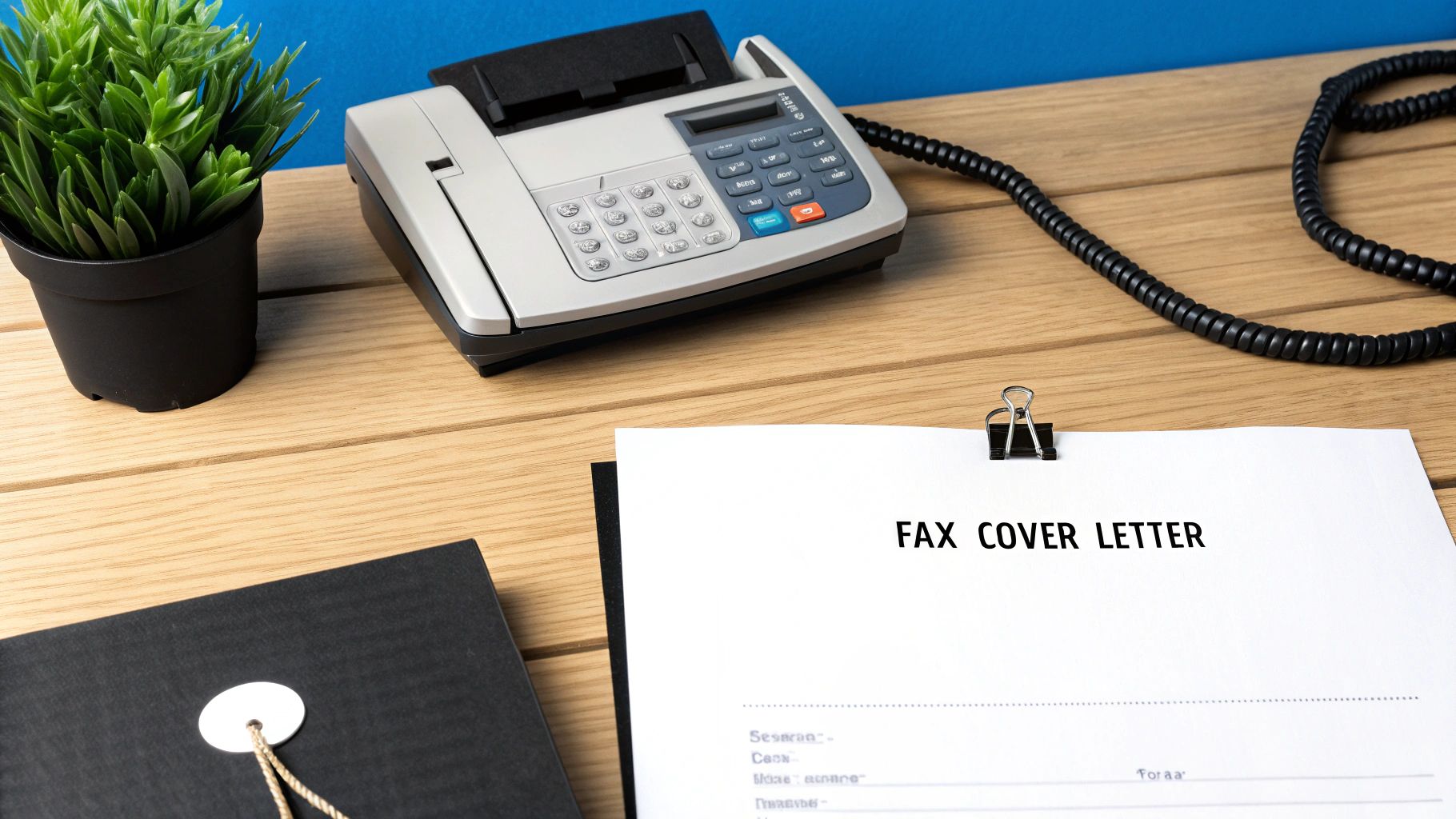
I get it. In a world full of emails and instant messages, sending a fax can feel a bit old-school. But for many critical industries—like healthcare, law, and government—faxing is still the gold standard for secure, legally binding communication. And for these important transmissions, the fax cover letter is your first impression.
It’s more than just a formality; it’s a practical tool that provides immediate clarity and context. Sending a fax without one is like mailing a package with no label. It might eventually get to the right place, but it causes a lot of confusion along the way.
The Purpose Behind the Page
A well-written cover letter performs a few essential jobs that prevent mix-ups and make sure your documents are handled correctly from the moment they arrive.
- It identifies everyone involved. The cover letter clearly states who sent the fax and who it's meant for. This is absolutely critical in big offices where a single fax machine might serve dozens of people across different departments. To get a better handle on this, you can dig into the specifics of what is a fax number.
- It explains what you're sending. A short message gives the recipient a heads-up on the contents, whether it's a signed contract, a patient referral, or an urgent legal notice.
- It confirms the page count. By listing the total number of pages (including the cover sheet itself), you give the recipient an easy way to verify they've received the complete document. No more guessing if a page got lost in transmission.
- It sets a professional tone. It just looks better. A cover letter shows you're organized, detail-oriented, and serious about your communication.
When fax machines took over the business world in the 1980s, the cover letter quickly became standard practice. And while technology has evolved, its role hasn't diminished in key sectors. As recently as 2018, US healthcare providers still relied on fax for 75% of all communications. You can learn more about its history from this resource on faxing cover letters on Indeed.com.
Ultimately, taking a minute to include a cover letter ensures your faxes aren't just received—they’re understood, respected, and acted on quickly.
Essential Elements of a Fax Cover Letter
To make sure your cover letter does its job, it needs to include a few key pieces of information. Here's a quick breakdown of what to include every single time.
| Component | Purpose | Example |
|---|---|---|
| Your Information | Identifies you as the sender and provides return contact details. | Jane Doe, Acme Corp., (555) 123-4567 |
| Recipient's Information | Ensures the fax is routed to the correct person and department. | Attn: John Smith, Legal Department |
| Date | Provides a timestamp for when the document was sent. | October 26, 2023 |
| Page Count | Helps the recipient confirm the entire transmission was received. | 5 pages (including cover) |
| Subject Line | Gives a clear, concise summary of the fax's content. | RE: Signed Contract #BN-7890 |
| Message/Comments | Offers space for a brief note, instructions, or context. | "John, here are the signed documents we discussed. Please confirm receipt." |
Getting these simple details right is the first step toward effective and professional fax communication.
Writing a Clear and Professional Message
Once you’ve filled in the sender and recipient details, you get to the core of your fax cover letter: the message itself. It's easy to overthink this part, but in my experience, the best messages are direct, professional, and surprisingly short. Your goal is simply to give the recipient enough context to understand the fax's purpose at a glance.
Think of it this way: this isn't a job application where you're trying to impress someone with your prose. It's a functional, professional note. The person on the other end is busy and just needs to know what the document is and what to do with it. Anything extra just gets in the way.
Crafting the Perfect Subject Line
The subject line (usually marked "RE:" or "Subject") is your first and best chance to tell the recipient what’s inside. A vague subject like "Documents" is practically useless. Instead, get specific. Use references the recipient will recognize right away.
Here are a few examples of effective subject lines I see work all the time:
- Invoice or PO numbers: "RE: Invoice #INV-2024-881"
- Patient or client names: "RE: Medical Records for John Smith, DOB 05/15/1980"
- Case or file numbers: "RE: Signed Documents for Case #L-45921"
- A clear action requested: "RE: Urgent Signature Required – Client Agreement"
Getting this one small detail right means your fax is far more likely to get routed to the right person and handled with the correct priority.
Keeping the Message Body Concise
The main message area should be no more than two or three short sentences. Seriously. Treat it like a digital sticky note attached to your documents. Its only job is to provide a little context and a clear next step.
Start by saying what you're sending. Something like, "Please find the signed contract for the Q4 marketing services attached" immediately confirms the document's contents.
Then, tell them exactly what you need them to do. This "call to action" removes any guesswork.
A great call to action is polite but direct. For instance, "Please review and file these records," or "Kindly sign and return to my attention by end of day." The goal is to make the next step totally obvious.
Steer clear of unnecessary fluff. Phrases like "I hope you are having a great week" are nice, but they clutter the message and distract from the core purpose. Just get straight to the point.
Here’s a quick look at a weak message versus a strong one:
| Weak Message (Vague & Wordy) | Strong Message (Clear & Actionable) |
|---|---|
| "Hi Sarah, Here are the papers we talked about. Let me know what you think when you get a chance. Thanks!" | "Sarah, Attached are the final blueprints for the Harrison project. Please approve and return by Friday, Oct. 28th." |
The second example is far better. It's professional, provides a specific reference ("Harrison project"), and sets a clear deadline. That’s the standard to aim for with every fax cover letter. Keeping your message sharp ensures your communication is not only received but acted on quickly.
Fax Cover Letter Templates for Any Scenario
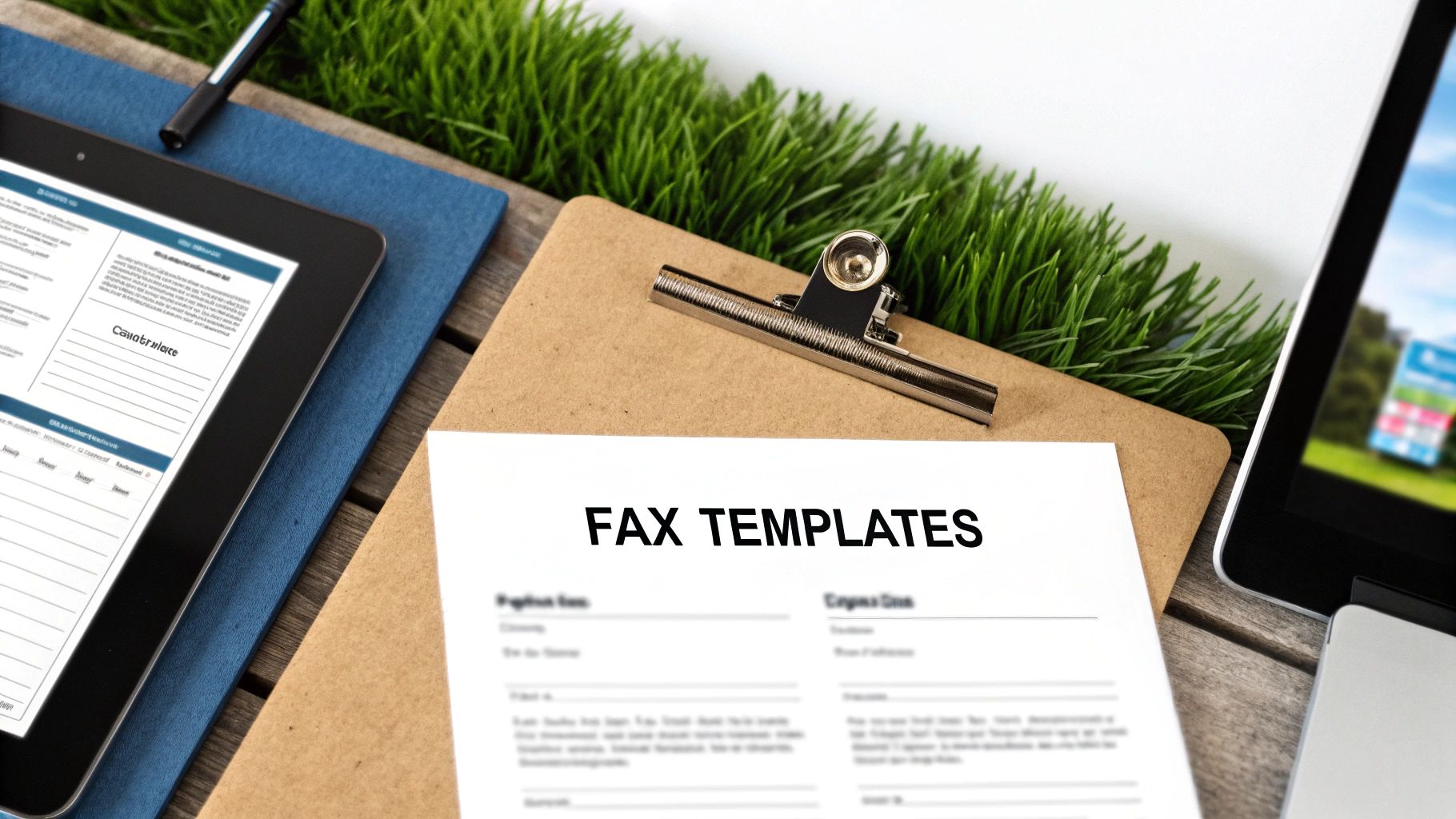
Starting with a blank page is never easy. To help you get your faxes out the door faster and looking professional, we've put together a few ready-to-use fax cover letter templates for common, real-world situations. Think of these as a jumping-off point—a solid foundation you can quickly tweak for your specific needs.
Each template is built for a particular purpose, highlighting the key information that recipients in those fields are looking for. Just copy and paste the text, then fill in the [Your Information] fields.
Medical Records Request Template
When you're dealing with healthcare, precision and privacy are paramount. This template is specifically designed for requesting patient records, so it includes crucial fields like Date of Birth (DOB) and Patient ID. Including these details right up front helps prevent dangerous mix-ups and ensures the request gets to the right file.
And, of course, the confidentiality notice isn't optional—it's a standard, non-negotiable part of any medical communication.
Template:TO: [Medical Records Department Name/Contact Person]FAX: [Recipient's Fax Number]FROM: [Your Name/Office Name]FAX: [Your Fax Number]DATE: [Date]PAGES: [Total Number of Pages, Including Cover]SUBJECT: Medical Records Request for [Patient Full Name], DOB: [Patient DOB]
COMMENTS:Please find attached a signed authorization for the release of medical records for the patient named above.
This fax is intended only for the use of the individual or entity to which it is addressed and may contain information that is privileged, confidential, and exempt from disclosure under applicable law. If you are not the intended recipient, you are hereby notified that any dissemination, distribution, or copying of this communication is strictly prohibited.
Legal Document Submission Template
In the legal field, everything revolves around proper documentation. This fax cover letter template puts the case or matter number front and center in the subject line, which is absolutely vital for getting it filed and routed correctly in a busy law office or court clerk's office.
The message itself is direct and formal, which matches the professional standards of the legal industry. No fluff, just the facts.
Template:TO: [Recipient's Name/Firm Name], Attn: [Contact Person]FAX: [Recipient's Fax Number]FROM: [Your Name/Your Firm's Name]FAX: [Your Fax Number]DATE: [Date]PAGES: [Total Number of Pages]RE: Submission of Documents for Case No. [Case or Matter Number]
COMMENTS:Attached are the signed documents pertaining to the above-referenced case. Please confirm receipt at your earliest convenience.
The information contained in this facsimile message is legally privileged and confidential information intended only for the use of the individual or entity named above. If the reader of this message is not the intended recipient, you are hereby notified that any dissemination, distribution, or copying of this communication is strictly prohibited.
Job Application Submission Template
Believe it or not, some government agencies and long-established corporations still accept job applications via fax. If you find yourself in that situation, this template will help you present your materials professionally. It’s intentionally brief, acting as a simple introduction to guide the hiring manager to your more detailed resume and full cover letter.
Even in a fax, that cover sheet makes a big first impression. Research shows 94% of hiring managers believe cover letters can sway interview decisions, and 83% read them often. That sentiment still holds true for faxed applications, where a polished cover sheet sets a professional tone before they even see your qualifications. You can find more stats on how cover letters matter over at Resume Genius.
Template:TO: [Hiring Manager Name or Human Resources Department]FAX: [Company's Fax Number]FROM: [Your Full Name]FAX: [Your Fax Number]DATE: [Date]PAGES: [Total Number of Pages]RE: Job Application for [Position Title]
COMMENTS:Please accept this fax as my formal application for the [Position Title] role advertised on [Platform, e.g., company website, LinkedIn]. Attached you will find my detailed cover letter and resume for your review.
Pro Tip: When you fax a job application, you're really using two "cover letters." The first is the fax cover sheet (this template), which is just a quick routing slip. The second is your traditional, detailed cover letter, which should come immediately after the fax cover sheet and right before your resume.
Template Quick Guide: Which One to Use
Not sure which template fits your situation? This quick guide breaks down when to use each one and what makes them unique.
| Template Type | Best For (Scenario) | Key Included Fields |
|---|---|---|
| Medical | Requesting patient health records from a hospital or clinic. | Patient Name, Date of Birth (DOB), Confidentiality Notice |
| Legal | Submitting official documents to a law firm or court. | Case/Matter Number, "Attn:" Line, Legal Privilege Disclaimer |
| Job Application | Applying for a position with an organization that accepts faxed resumes. | Position Title, Source of Job Listing (e.g., website) |
Each template provides the essential framework, so you just need to fill in the details and you're ready to send.
Common Mistakes That Undermine Your Fax
Sending a fax might seem simple, but I've seen countless small slip-ups cause big problems. A sloppy fax cover letter doesn't just look unprofessional; it can get your entire transmission misrouted, ignored, or even lost altogether. Knowing what pitfalls to avoid is the key to making sure your documents land in the right hands and are taken seriously.
The most common error I see? Simply getting the recipient’s information wrong. You absolutely have to double-check the fax number. One wrong digit sends your documents into a black hole—or worse, to a total stranger. It’s also surprisingly easy to misspell a name or use the wrong job title, which can leave the receiving office scratching their heads trying to figure out where the fax needs to go.
Content and Clarity Blunders
Even if you nail the contact details, the content of the cover letter itself can trip you up. Vague subject lines are a classic mistake, as are messages that ramble on for too long. Nobody has time to read a novel; they need to know what your fax is about, and they need to know now.
Another huge oversight is forgetting to include the total page count. This little detail is a critical safeguard. Back in the fax heyday of the 1990s, it wasn't uncommon for transmission glitches to drop 10-20% of pages. The page count on the cover letter was the only way for the recipient to know if they got everything, a best practice that’s still crucial today for clarity and compliance. You can learn more about the history behind cover letters in this great piece from HR Brew.
Here are a few other content mistakes to watch out for:
- Forgetting a Confidentiality Notice: If you're sending legal, medical, or financial documents, this isn't optional. It's a standard protective measure that should be on every sensitive transmission.
- Using Casual Language: Always keep your tone professional. Save the slang, emojis, and overly familiar greetings for a text message.
- Poor Scan Quality: Sending a blurry or crooked document is the digital version of handing someone a crumpled, coffee-stained report. Make sure your scans are clean and perfectly legible before you hit send.
Technical and Security Oversights
Finally, let's talk about the technical side. Even a perfectly written cover letter won't save you from a bad transmission method. Using a public fax machine at a library or copy shop, for example, is a major security risk. You have no idea who might glance at your sensitive documents.
Sending sensitive information requires a trusted method. Many free online services lack the security protocols necessary for confidential data, which is why it's crucial to understand their limitations.
This is especially true for legal and healthcare records, where privacy is governed by strict regulations like HIPAA. If you’re sending sensitive files, do your homework on the service you’re using. For a deeper dive, our guide on whether services like FaxZero are safe is a good place to start. By steering clear of these common mistakes, you can make sure your faxes are professional, secure, and effective every single time.
Using an Online Fax Service to Handle Cover Pages
If you've ever used an old-school fax machine, you probably remember the hassle of printing a separate fax cover letter for every single thing you sent. It was tedious, and frankly, a waste of paper. Thankfully, today’s online fax services have completely changed the game by building cover page management right into the workflow. This makes sending a professional-looking fax not just easier, but a whole lot faster.
Instead of fumbling with a separate document, these platforms let you create a default cover page that automatically populates with your contact info and company logo. This little touch ensures every fax you send looks consistent and professional, reinforcing your brand without any extra effort on your part. You just type your message, and the service takes care of the rest.
Getting Your Cover Page Just Right
The real beauty of a digital fax service is the control it gives you. Let’s take the SendItFax platform as a practical example. When you log in, you'll typically find a settings menu where you can fine-tune all your cover page options.
It’s usually a simple control panel with a few toggles to manage your preferences.
As you can see, it's incredibly straightforward. You can turn the cover page on or off with a single click or upload a logo to give your faxes a custom look.
From a dashboard like this, you can usually manage a few key things:
- Create a Default Template: Set up a master cover page with your logo and contact details. This becomes your go-to for all outgoing faxes unless you decide otherwise.
- Toggle On or Off Per Fax: Sending a quick, informal document to a colleague? Just uncheck a box before hitting send. This gives you complete control over each transmission.
- Write Custom Messages: The "Comments" or "Message" field is where you can type a unique note for the recipient, just like you would on a paper cover sheet.
The ability to add or remove a cover page on the fly is a massive time-saver. Think about it: an internal invoice might not need a formal cover sheet, but a contract sent to a new client absolutely does. Digital faxing gives you that choice without the headache.
Finding the Right Service for Your Business
This level of control has become a standard feature for most top-tier providers. It turns the fax cover letter from a manual chore into a simple, integrated part of your process. When you’re shopping around for a service, make sure intuitive cover page management is on your checklist, along with other must-haves like delivery confirmations and strong security.
Choosing the right tool can make a real difference in your day-to-day efficiency. To see how different platforms compare, take a look at our detailed guide to the best online fax services and find one that fits your needs.
Frequently Asked Questions About Fax Cover Letters
Even after you've got the basics down, a few tricky questions always seem to pop up. These are the real-world, "what-if" scenarios that can make you hesitate right before sending a fax. I've pulled together the most common questions I hear to give you clear, no-nonsense answers.
Think of this as your quick-reference guide to handle those last-minute doubts and make sure every fax you send lands perfectly.
Is a Fax Cover Letter Legally Required?
This is a big one. While there isn't a universal law that says you must use a cover letter for every single fax, it’s often an absolute necessity for compliance in certain fields.
Take healthcare, for instance. A cover page that includes a HIPAA confidentiality notice is standard procedure to protect sensitive patient information. It’s not just a good idea; it's a critical part of the process. The same goes for legal communications, where a cover sheet helps establish a formal record and asserts legal privilege.
In most other professional settings, it's simply good business practice. The company you're faxing might even have its own rules that require a cover sheet to make sure your documents get routed to the right person.
Can I Handwrite a Fax Cover Letter?
You can, but I almost always advise against it. In any professional context, a typed cover letter just looks better. It's clean, easy to read, and you completely avoid the risk of someone misreading your handwriting. Plus, modern online fax services make it so easy to type a message directly into a digital template.
If you're ever in a real pinch and handwriting is your only option, follow these tips:
- Use a clean, unlined sheet of white paper.
- Write with a black ink pen. It scans much more clearly than blue.
- Print as neatly as you possibly can. Readability is everything.
What's the Difference Between a Fax Cover Letter and a Regular Cover Letter for a Job Application?
This is a classic mix-up. A fax cover letter (or cover sheet) is short and to the point. Its main purpose is to act like the outside of an envelope, providing key details: who it's from, who it's for, the date, and the total number of pages. The message is usually just a quick sentence or two.
A regular cover letter for a job application is a completely different beast. It's a detailed, persuasive document—usually a full page—that builds on your resume. You use it to show off your skills, let your personality shine, and make a strong case for why you're the right person for the job.
When you fax a job application, you need both. The fax cover sheet always goes on top to direct the whole package. It's followed by your formal cover letter, and then your resume.
Do I Still Need a Cover Page for a Single-Page Fax?
Yes, you really should. It might seem like overkill, but that cover page provides critical context that the document itself might be missing. It ensures your single page gets to the right desk in the right department without anyone having to play detective.
It also confirms the transmission was successful. By stating the page count is "2 (including cover)," you eliminate any doubt on the recipient's end about whether a page got lost. It’s a small, simple step that adds a layer of professionalism, no matter how short the document is.
Ready to send your faxes without the fuss? SendItFax lets you upload your documents, add a professional cover page, and send it on its way in minutes. For just $1.99 per fax, you can send up to 25 pages with priority delivery and no branding. Try it now at SendItFax.
Related Posts
Fax to PDF: The Modern Guide to Digital Faxing in 2026
Resource Allocation Optimization: A Practical Guide