Fake Fax Numbers Explained Risks and Safe Alternatives
You're filling out a form for a doctor's office, a school, a lender, or a government agency. Everything is easy until one field stops you: fax number. You don't own a fax machine. You don't want to give out your personal phone number. You're tempted to type something that looks right and move on.
That small shortcut is where people start searching for fake fax numbers.
The idea sounds harmless. If the field is required, why not enter a made-up number? If you only need to send one document, why bother setting up a real fax line? And if privacy is the concern, maybe a fake number feels safer than exposing your own details.
The trouble is that people use the phrase “fake fax number” to mean three very different things. Some mean a placeholder number they never expect anyone to use. Others mean a spoofed identity, where a sender tries to make a fax appear to come from a different number. Others really want a legitimate virtual fax number that protects privacy without breaking delivery.
Those are not the same problem. They don't carry the same risk. And they definitely don't lead to the same result.
A failed fax isn't just annoying when the document is time-sensitive. It can delay a medical form, stall legal paperwork, confuse recordkeeping, or send a recipient looking for a reply path that doesn't exist. That's why it helps to understand what a fax number is before deciding what to put in that field.
Introduction Why Fake Fax Numbers Tempt Busy Senders
A lot of occasional senders run into the same moment. You need to submit a signed form today. The office says it accepts fax. You open an online fax tool or a PDF form, and one box asks for your fax number. You pause because you don't really have one.
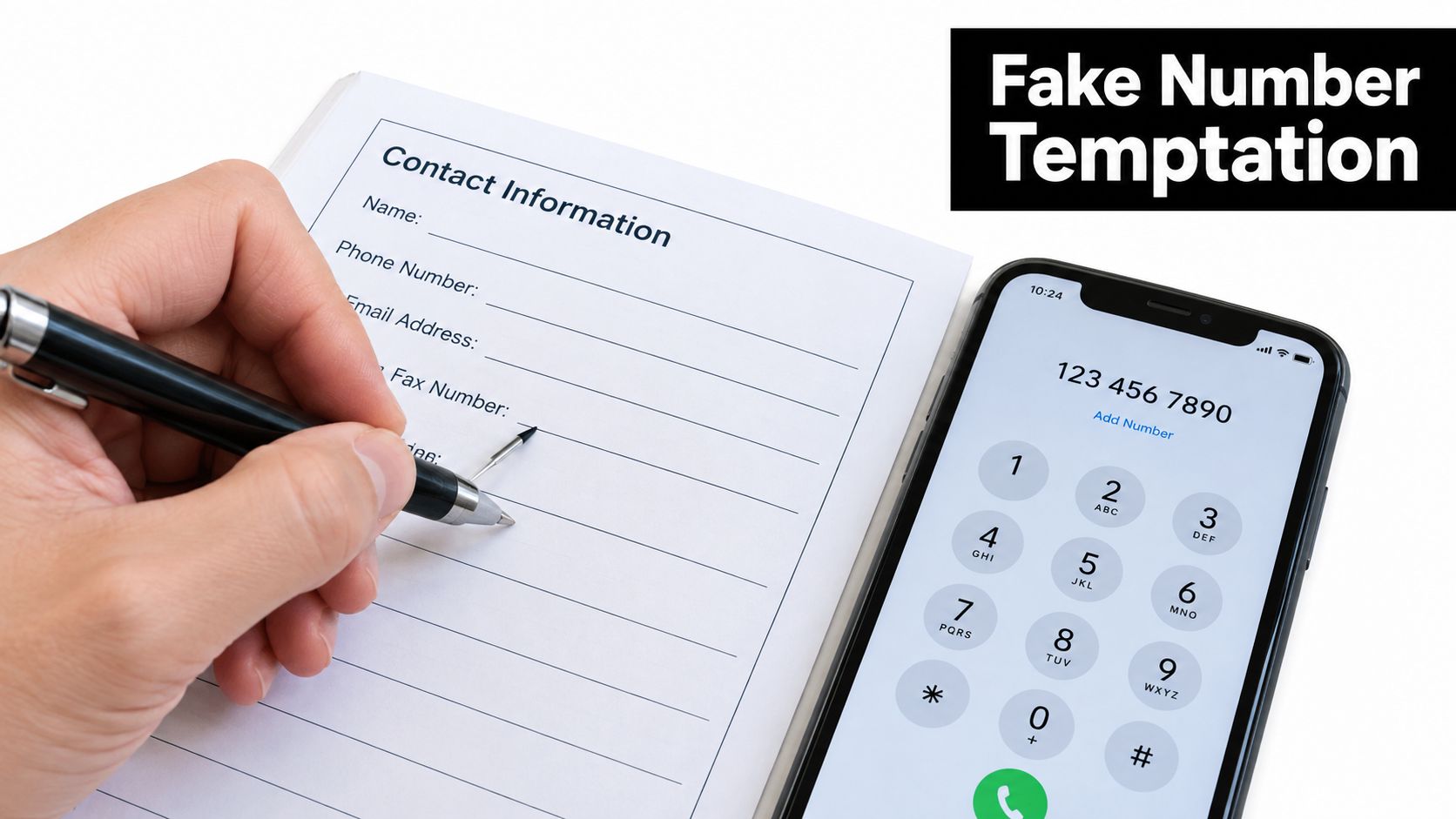
For many people, that field feels more formal than useful. You may think, “They only need a number because the form was designed years ago.” That assumption is why fake fax numbers look tempting. They seem like a quick fix for an outdated requirement.
Why the shortcut feels reasonable
Fax has a long history, which helps explain why these fields still show up. The roots go back to 1843, when Alexander Bain created the Electric Printing Telegraph, and later milestones such as Xerox's 1966 Magnafax Telecopier helped move faxing into broader business use. Faxing then became common in offices and homes during the 1980s and 1990s, which turned fax numbers into a normal business identifier across many industries, as described in this history of fax technology.
That history created a habit that still affects forms today. Even when people send documents from a browser instead of a machine, the workflow often still expects a return path.
Practical rule: If a form asks for a fax number, treat it as a contact and routing field, not just a decoration.
What people usually mean by fake fax numbers
When readers ask about fake fax numbers, they're often talking about one of these situations:
- A required field problem. You need to finish a form and don't want to leave the line blank.
- A privacy problem. You want to send a fax without exposing your personal number.
- An identity problem. You want the recipient to see a different fax number than the one used.
- A trust problem. You received a fax number from someone else and want to know whether it's real before sending records.
Those are very different jobs. A made-up number might satisfy your eyes, but it won't help if the recipient needs to reply, verify the sender, or match the fax to a record later.
The real cost of getting it wrong
The biggest issue isn't that a fake number looks odd. It's that it creates uncertainty at the exact moment you want certainty. If the document matters, you want a fax number that can receive or identify traffic in a way the other side can trust.
That's why the safer question isn't “Can I get away with a fake fax number?” It's “What kind of number do I need here?”
What a Fax Number Really Is and Why Fakes Fail
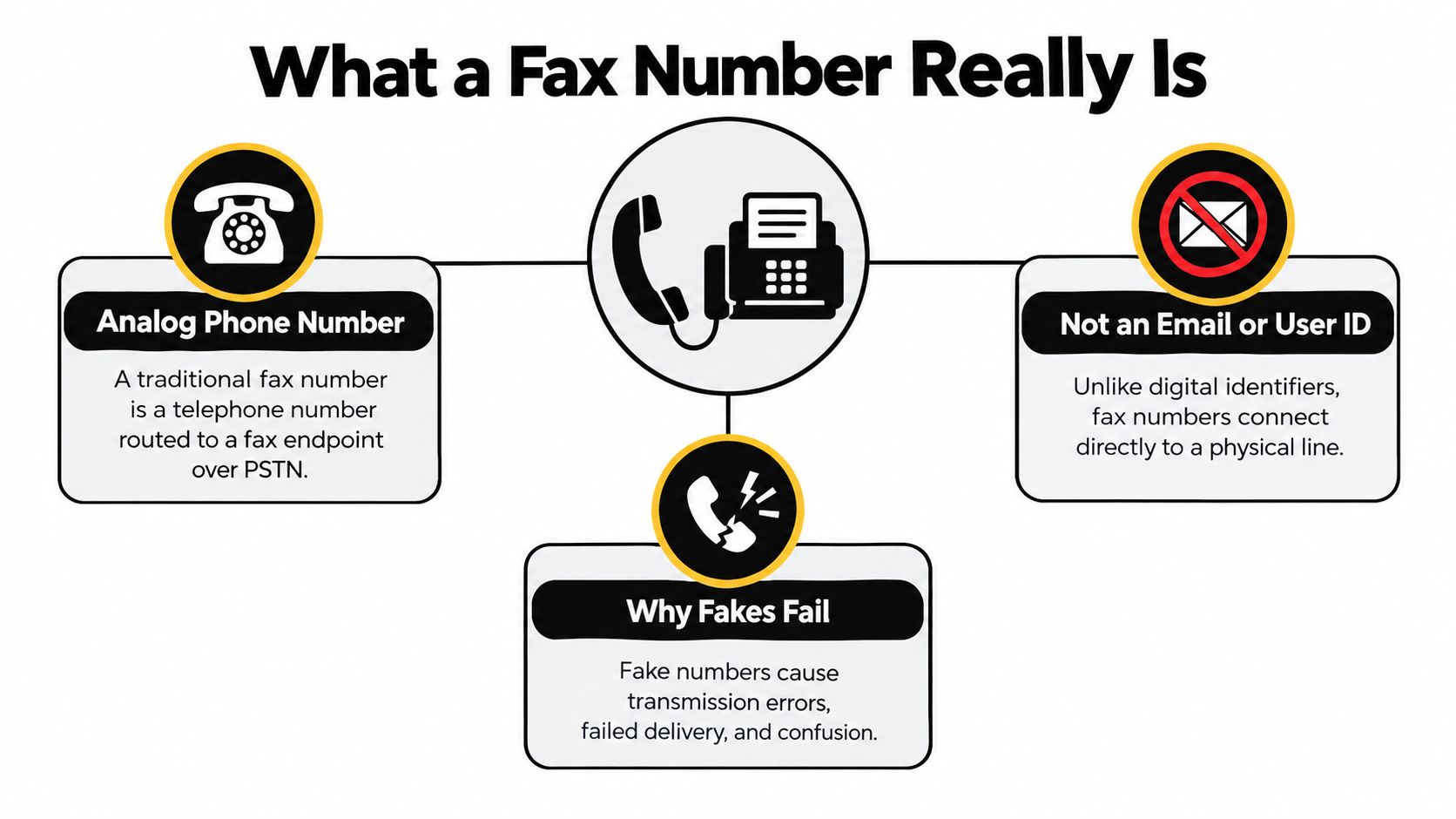
A fax number isn't magic. In the traditional setup, it's a telephone number routed to a fax endpoint. On older phone infrastructure, it uses the same basic line behavior as a voice call. It isn't a separate identity layer like an email address or username, which is why a plausible-looking number can still fail when you try to use it, as explained in this guide to what a fax line is and how it works.
If you want a deeper plain-English primer, this walkthrough on what a fax number is is useful because it starts from the phone-number model rather than app language.
Think of it like calling a house
A fake fax number can look fine on paper, just like a fake street address can look fine in a form field. But delivery only works if something real exists at the destination.
With fax, that “something real” is not just digits in the correct format. It's an endpoint that answers like a fax device or service.
- Format is not enough. A string of digits may pass a form check.
- Routing is what matters. The number has to reach a live line or service.
- Answer behavior matters too. The destination must behave like fax equipment, not just any phone endpoint.
Why the handshake matters
Fax delivery depends on protocol timing and signal exchange. Cisco's fax guidance explains that successful transport relies on T.30 session expectations, and that without spoofing support a fax machine may time out after roughly 60 to 90 seconds of perceived silence. The same guidance also describes spoofing techniques and line padding used to keep machines on line long enough to complete negotiation, which you can read in Cisco's fax transport documentation.
That sounds technical, but the everyday version is simple. A fax sender doesn't just toss a file into the void. It “calls,” waits for the right response, and continues only if the other side answers correctly.
A number can look valid in a directory and still fail in real use because no true fax session starts.
A quick mental model
Use this checklist whenever you wonder whether a number is real:
| Check | What you're asking |
|---|---|
| Looks right | Does it match a normal phone-number format? |
| Routes somewhere | Does it connect to a live line or service? |
| Acts like fax | Does the endpoint answer and negotiate properly? |
| Can be trusted | Is it actually the right number for this recipient? |
That's why made-up numbers are poor substitutes. They may satisfy the shape of a fax number, but they usually fail the function of one.
Fake Versus Virtual Versus Spoofed Fax Numbers Compared
Most confusion comes from lumping different tools into one bucket. A fake placeholder number, a spoofed identity, and a legitimate virtual fax number can all be described casually as “not a normal fax line,” but they behave very differently.
Fake vs Spoofed vs Virtual Fax Numbers at a Glance
| Number Type | What It Is | Will It Deliver | Main Risk |
|---|---|---|---|
| Fake placeholder number | A made-up or inactive number entered to satisfy a field | No, not reliably | Failed replies, broken records, lost trust |
| Spoofed fax identity | A transmitted identity made to appear as a different sender number | Maybe, depending on service and controls | Legal and compliance problems |
| Virtual fax number | A real number tied to an online fax service | Yes, if the service is active and configured | Using the wrong provider or wrong recipient number |
| Privacy relay or alternate business number | A legitimate forwarding or managed number used for routing or privacy | Yes, when properly managed | Confusing it with deceptive spoofing |
The three reader jobs hiding inside one search
If you search for fake fax numbers, you're probably in one of these camps:
You just need to get through a required field
This is the placeholder-number crowd. The goal isn't deception in a dramatic sense. It's speed. But the risk is practical. If the recipient stores that number and later tries to confirm a page, request a corrected form, or match a transmission to your records, the trail goes cold.
You want privacy without exposing a personal line
A virtual fax number or managed alternate number makes sense. It gives you a real endpoint without forcing you to publish your direct phone number. That's not the same as faking identity. It's closer to using a business mailbox instead of your home address.
You want the fax to look like it came from somewhere else
That's a spoofing question, not a placeholder question. It crosses into identity, carrier policy, and compliance. It also overlaps with the broader challenge of verifying communications, which is why security teams spend so much time fending off phishing attacks in 2025 across channels that rely on familiar-looking contact details.
If your real need is privacy, use a real virtual number. If your real need is disguise, stop and check the rules before sending anything.
The simplest way to choose
Ask one question first: Do I need this number to work, or do I only need the field not to be blank?
If the document matters, you need a number that works. That pushes you away from placeholders and toward a real virtual or managed number. In other words, the safe option usually isn't “fake.” It's “real, but not personal.”
Legal and Security Risks You Should Not Ignore
The legal problem with fake fax numbers isn't just the made-up digits. It's the possibility of misleading identity, breaking consent rules, or creating a communication trail that can't be trusted later.
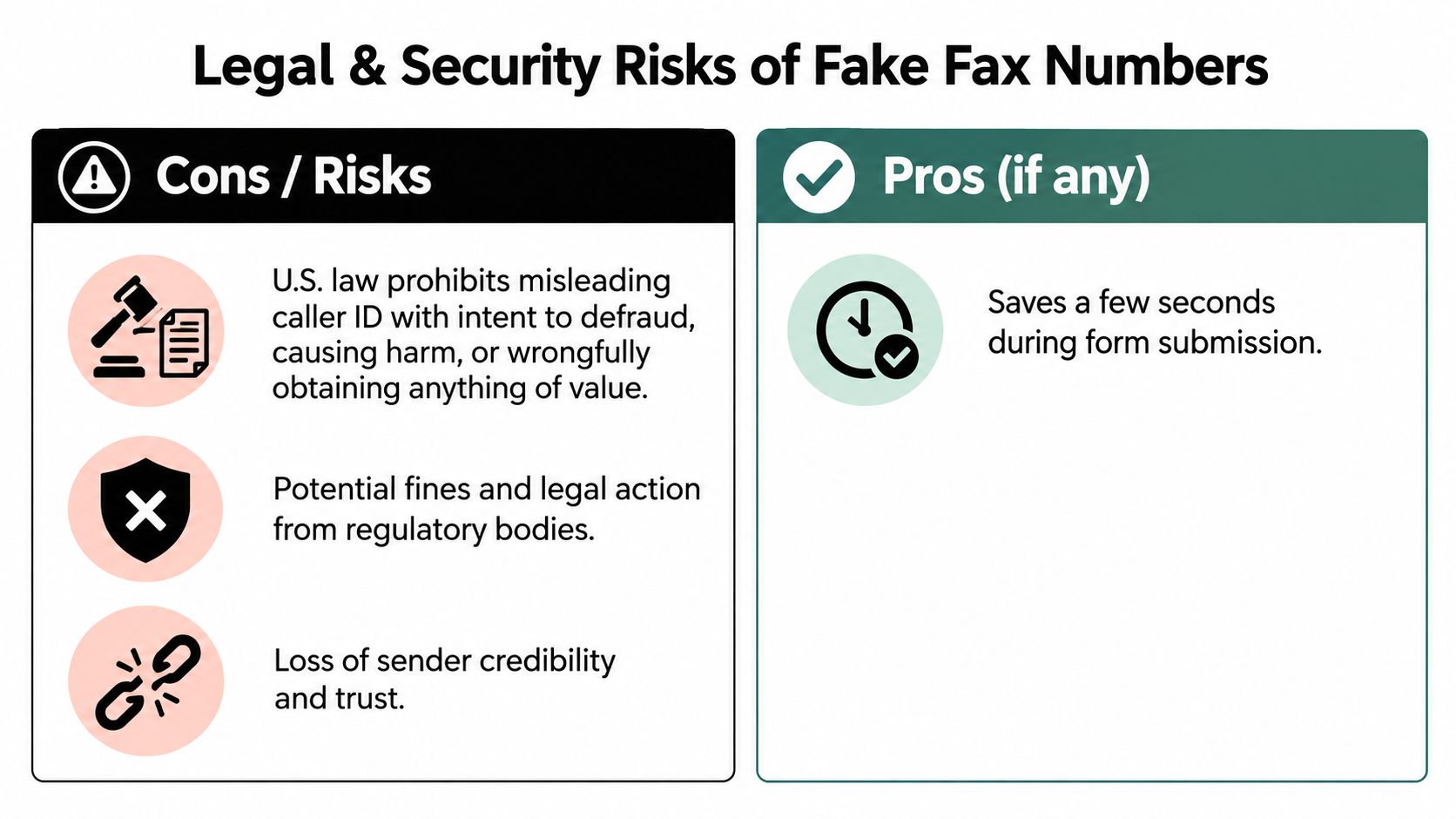
The FCC notes that misleading caller ID with intent to defraud or cause harm is illegal, and its unwanted-communications enforcement area also addresses junk-fax rules and sender identification requirements. That broader context matters because people often collapse spoofing, caller ID, and fax identity into one idea when they're not the same thing. The FCC's unwanted communications enforcement guidance is the clearest starting point on that point.
Where people get exposed
A fake or unreliable fax number creates problems in several layers at once:
- Delivery risk. The recipient may have no usable way to respond.
- Record risk. A bad number weakens the chain of who sent what.
- Compliance risk. Marketing or regulated transmissions can depend on how the number was obtained and whether the communication is lawful.
- Fraud risk. A familiar-looking fax number can be used to create false confidence.
The trust issue reaches beyond fax. If you handle sensitive documents at work, practical data safety best practices help because the same habits that protect email and files also reduce mistakes in fax workflows.
Why number provenance matters
The FCC's junk-fax guidance makes an important point. Compliance can depend on whether the sender got the number through permission, an established business relationship, or a publicly listed source. In plain language, where the number came from matters almost as much as the number itself. You can review that in the FCC's junk fax FAQs.
That's especially relevant for records, legal notices, and regulated forms. If the number is wrong, recycled, mistyped, or only “looks official,” your transmission may land in the wrong place or fail to support the record you thought you created.
For a broader look at the confidentiality side of online faxing, this explanation of the security of fax helps connect transport questions with document-handling risks.
A safer standard for everyday senders
Instead of asking whether a number “looks valid,” ask:
- Was this number provided by the actual recipient?
- Can the recipient confirm it in a trusted channel?
- Is this number appropriate for the type of document I'm sending?
- Will I have proof of transmission and enough information to follow up?
A fax number is part routing detail, part identity clue, and part compliance artifact. Treat it that way.
Common Misconceptions About Fake Fax Numbers
People get into trouble with fake fax numbers because several myths sound reasonable at first glance. Fax is old technology, many forms still use old layouts, and a string of digits looks easy to fake. That combination leads to false confidence.
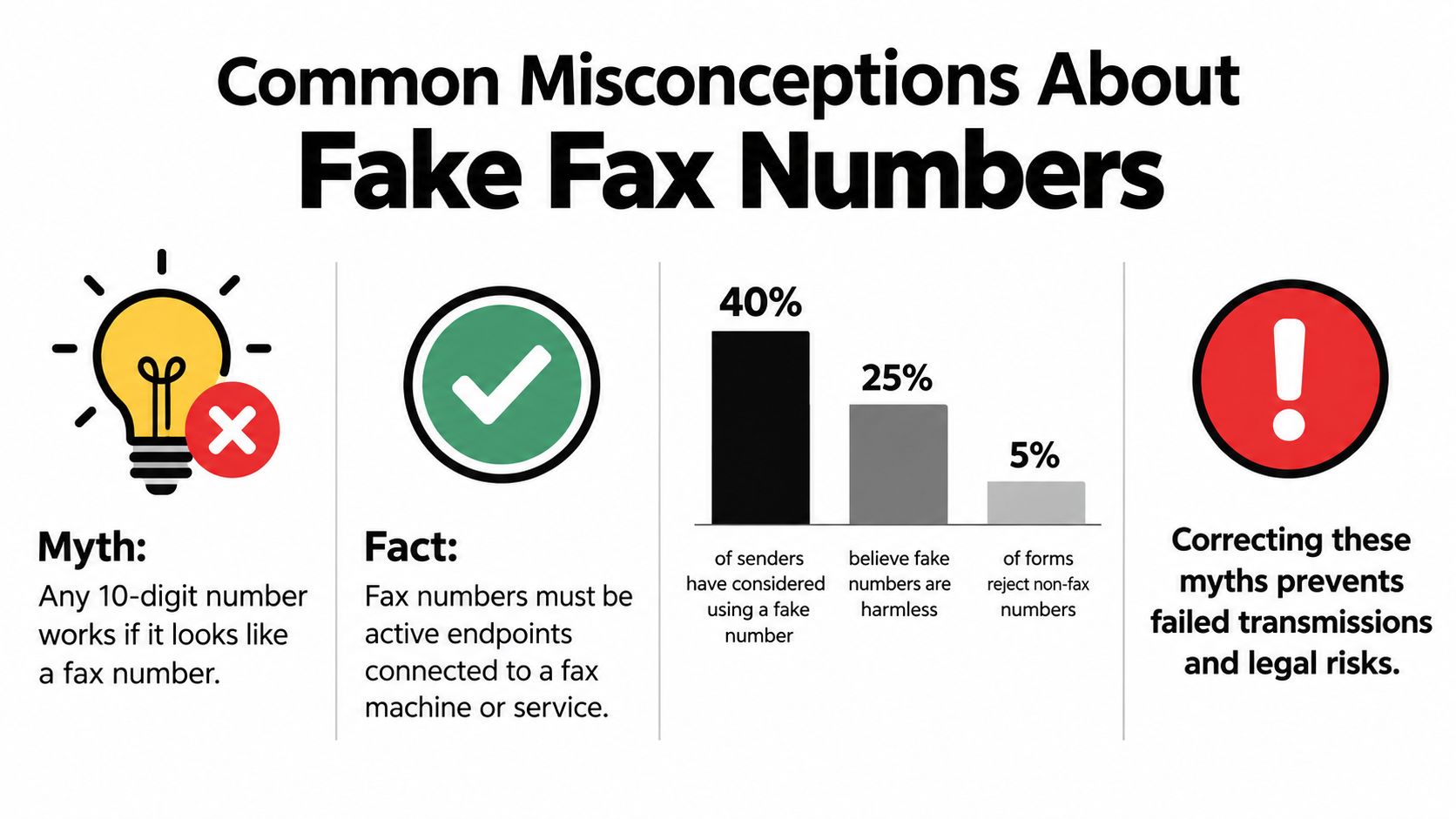
Myth Any normal-looking number will work
Reality is less forgiving. A fax number has to be attached to a working destination. Looking plausible is not the same as being reachable.
This is the most common misunderstanding because many web forms only check whether a number fits a pattern. They can't tell whether the other end is real.
Myth Spoofing and virtual fax are the same thing
They're not. A virtual fax number is still a real number managed by a service. A spoofed identity tries to make the transmission appear to come from a different source.
That difference matters because one is a privacy tool and the other can become a deception issue.
Myth Fax is too outdated to matter to scammers
Fax may be a smaller scam channel than others, but it's still present in official reporting. New Zealand's Department of Internal Affairs recorded 4 fax scams out of 593 total scams in 2010, 19 fax reports in 2011, 10 fax reports in another monthly breakdown, and 0 fax reports in both December 2010 and December 2013. Australia's ACCC reporting also listed fax as a scam channel with 530 reports and 0.6% in one annual table, and 625 reports and 0.7% in another year, according to the scam statistics cited here.
Those numbers don't mean fax is the biggest danger. They mean fax is real enough to appear in fraud reporting, which is why “old” doesn't equal “safe.”
Old systems often survive because organizations still rely on them. Attackers know that.
Myth A fake number only affects me
Not always. It can affect the person trying to reply, the staff member matching incoming documents, or the organization trying to verify a record later.
Here's the practical takeaway:
- If the number is just filler, expect confusion later.
- If the number is false identity, expect risk right away.
- If the goal is privacy, use a real managed number instead.
The mistake isn't only technical. It's assuming all nontraditional fax numbers belong in the same category.
Safe Alternatives for Privacy Conscious Faxing
If you don't want to expose a personal number, you have better options than fake fax numbers. The key is to pick a tool that gives you a real, reachable endpoint or lets you send without pretending to have one.
Better choices than making one up
Some occasional senders don't need a permanent fax number at all. They just need a browser-based way to send a document to a verified recipient. In that situation, an online fax tool can be enough, especially if the workflow only needs basic sender details and proof that the fax was submitted.
Other people need a number that recipients can recognize and use again later. That's where a virtual fax number or business-managed relay number helps. It protects privacy while still giving the other side a legitimate return path.
One example is SendItFax, a web-based fax service that lets users send faxes in the United States and Canada from a browser without creating an account, which can fit occasional or time-sensitive sending. If you're comparing options with privacy in mind, this guide to the safest online fax service is a useful checklist for what to verify.
How to verify a recipient number before you send
Use a simple pre-send routine, especially for medical, legal, financial, or school documents.
Check the source
Use the number published by the organization in its official materials, portal, or direct communication. Avoid copying a number from an old form if a newer contact page exists.Confirm the destination
Call the office's main listed number and ask whether that fax line is still active for the specific department. Fax numbers can be recycled, rerouted, or retired.Match the purpose
Some offices use different fax numbers for referrals, billing, records, and general intake. Sending to the wrong valid number is still a mistake.Use a cover page when needed
A cover page can help a recipient route the fax correctly, especially when a department handles many incoming documents.
A quick privacy checklist
| Need | Better option |
|---|---|
| One-time send | Browser-based outbound fax service |
| Ongoing replies | Virtual fax number from a verified provider |
| Personal privacy | Managed business or relay number |
| Sensitive records | Verified recipient number plus delivery confirmation |
Use a real number for privacy. Don't use a fake number for convenience.
The safest move is usually simple: choose a tool that gives you a real path without exposing more personal information than necessary.
Final Takeaways for Choosing a Real and Reliable Fax Number
Searching for fake fax numbers isn't about becoming a fax expert. It's about solving a small problem quickly. The trouble is that the phrase hides three different needs: filling a required field, protecting privacy, or changing displayed identity.
Those needs should lead to different decisions.
The decision rule that keeps you out of trouble
If you only need to complete a form, a fake placeholder might feel harmless. But if the document matters at all, that shortcut creates future confusion. It can block replies, weaken records, and make you harder to verify.
If your real concern is privacy, a virtual fax number or managed relay number is the right category. It's real, reachable, and built for routing. That's very different from a spoofed identity.
If you're thinking about making a fax appear to come from some other number, slow down. That's where compliance and deception concerns start to matter much more than convenience.
A simple test before every send
Ask these questions:
- Is this a real number tied to a working fax endpoint?
- Did I get the recipient's fax number from a trustworthy source?
- Will the other side be able to identify or reply to this transmission if needed?
- Am I protecting my privacy with a real service, or just hiding behind bad data?
That last question is the one many skip.
The clearest takeaway
Fake fax numbers usually fail because they try to solve the wrong problem. They look like a privacy tool, but they're often just broken contact information. A real virtual number or a reputable web fax workflow solves privacy more cleanly and with less risk.
So when that required fax field appears, don't ask whether the number can be fake. Ask whether it needs to be real, reachable, and defensible later. For anything important, the answer is yes.
If you need to send a fax without a machine or long setup, SendItFax offers a browser-based way to fax documents to U.S. and Canadian numbers, including a free option for small occasional sends and a paid option for longer or cleaner submissions. That makes it a practical fit when you need a real sending workflow instead of guessing with fake fax numbers. Visit SendItFax to see how it works.
Related Posts
Online Fax Website Guide: How to Choose the Right One
Online Fax PDF: How to Send Documents from Any Browser